Query language
Ask a table for rows by condition, follow references in a path, and group and count, in one line the address keeps.
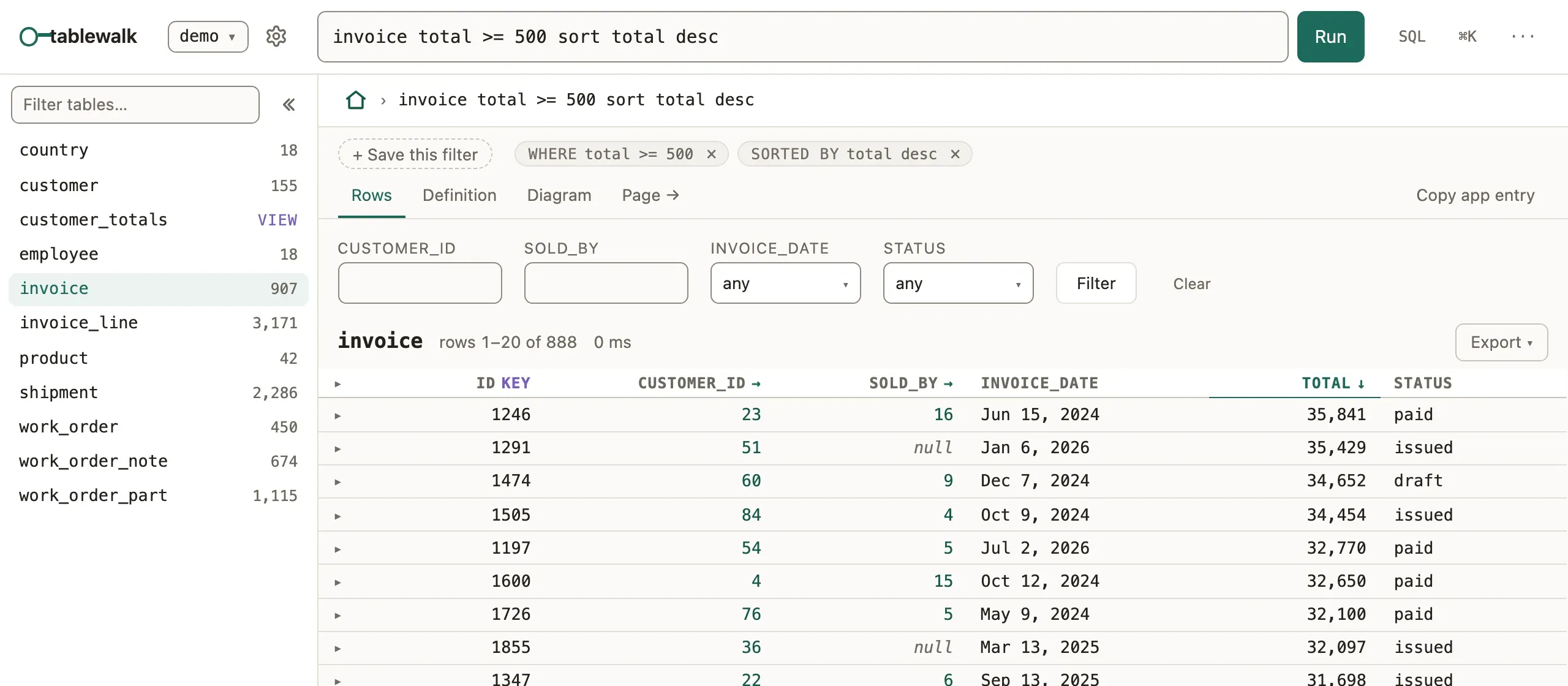
invoice total >= 500 sort total descType it into the bar above any table. Every example on this page runs against
npx tablewalk --demo.
What you’ll see
Section titled “What you’ll see”- Only the matching rows, with a count that stops at 10,000 and says so.
- The line written into the address (
/demo/invoice%20total%20%3E%3D%20500…), so a copied link reruns it. - SQL beside the result shows the statement it compiled to, with every value bound as a parameter.
When to use it
Section titled “When to use it”- Use the query bar when you know the condition, not the record: overdue, over a limit, missing an email.
- Use the walk instead when you start from one record and want what is around it.
- Use raw SQL only for what the language cannot say (window functions, unions); it shows the same result grid but checks nothing for you.
Conditions
Section titled “Conditions”The table comes first; conditions, columns, sort and limit follow.
customer active = true sort credit_limit desccustomer country_code in (AU, NZ) and email is not emptyemployee title contains manager show first_name, last_nameinvoice total between 100 and 1000 and status = issuedinvoice invoice_date = last 30 days| Intent | Spelling |
|---|---|
| Compare | =, !=, <, <=, >, >=, between a and b |
| Compare two values | qty < reorder_at, paid < owed (a rollup): beside a number, a date or a flag, a bare word naming a column, rollup or computed column is its value; beside text it stays a word. An App’s lists, segments and when guards |
| Match text | contains, startswith, endswith (case-insensitive where the database allows) |
| Match a set | in (AU, NZ), not in (AU, NZ) |
| Check null | is empty, is not empty |
| A machine’s states | status is open (not final), status is onBench (a group it names), is not for the rest |
| Combine | and, or, parentheses |
| Choose columns | show (or select), with as to rename |
| Order and cut | sort column desc (or order by), limit 20 |
Dates are phrases: today, yesterday, this week, last month,
this quarter, last 30 days, next 7 days; previous 30 days is the window just before
last 30 days. Hours and minutes count from the instant: due_at = next 2 hours
is due within two hours, updated_at = last 30 minutes changed just now. now is the instant itself:
resolution_due_at < now is past due, in a segment, a list’s query and a metric’s alike. this quarter,
last quarter and next quarter are calendar quarters, from January, April, July and October; an App has no
fiscal year to start them elsewhere. A value with a space is quoted: name = "Kereru Coffee".
Follow a reference in a query
Section titled “Follow a reference in a query”A dotted path walks a foreign key, as many steps as the schema has:
invoice show id, total, customer_id.name as customer where total >= 500invoice customer_id.name startswith KAsk about the rows that point here
Section titled “Ask about the rows that point here”any asks whether a record has a row of another table pointing at it, and
where what that row must hold; no asks for none:
customer any invoice where status = voidcustomer no invoiceproduct any invoice_line where invoice_id.status = paidemployee no employee via manager_idWhen the other table points here through two references, via names the one
meant. Two any conditions may each be held by a different row; for one row
holding both, put both inside one: any invoice where (status = paid and total > 500).
In an App, a tab, a segment and a list’s { has } filter say the same.
Group and measure
Section titled “Group and measure”Measures come before by, then up to three grouping keys:
invoice count by statusinvoice count, sum total as billed by month invoice_date sort billed desc limit 12invoice where total > 100 count by customer_id.country_code.name as countrycustomer count distinct country_code as countries by activeMeasures: count, count column, count distinct column, sum, avg,
min, max. Date buckets: day, month, quarter, year. Here sort
names a column of the answer (billed), not a path.
Common mistakes
Section titled “Common mistakes”"totl" is not a column on invoice. Did you mean "total"?→ paths are checked against the catalog, so a typo is an error, never an empty result; take the suggestion.customer_id.name = Kereru Coffeeis refused → quote a value with a space:= "Kereru Coffee".Nothing called "total" is in this breakdown→ afterby,sortnames a column of the answer:sort billed desc.- An App’s tab or
whenwill not parse → it is this same language; thequery-grammarcheck code says at which character. In an App the strings are typed too, where the TypeScript project registers exactly one App’s schema (the limit).
Related
Section titled “Related”- Walk a database: follow one record’s references by clicking.
- MCP for coding agents:
queryandbreakdowntake these lines verbatim. - Keyboard:
/focuses the bar;⌘/opens it as a panel. - Lists: an App’s tabs and filters are written in this language.