Composing a list
A list reads as a tool when its columns are the ones a person scans for and its tabs are the ways the work divides. Lintel’s repairs and rent roll are the worked examples.
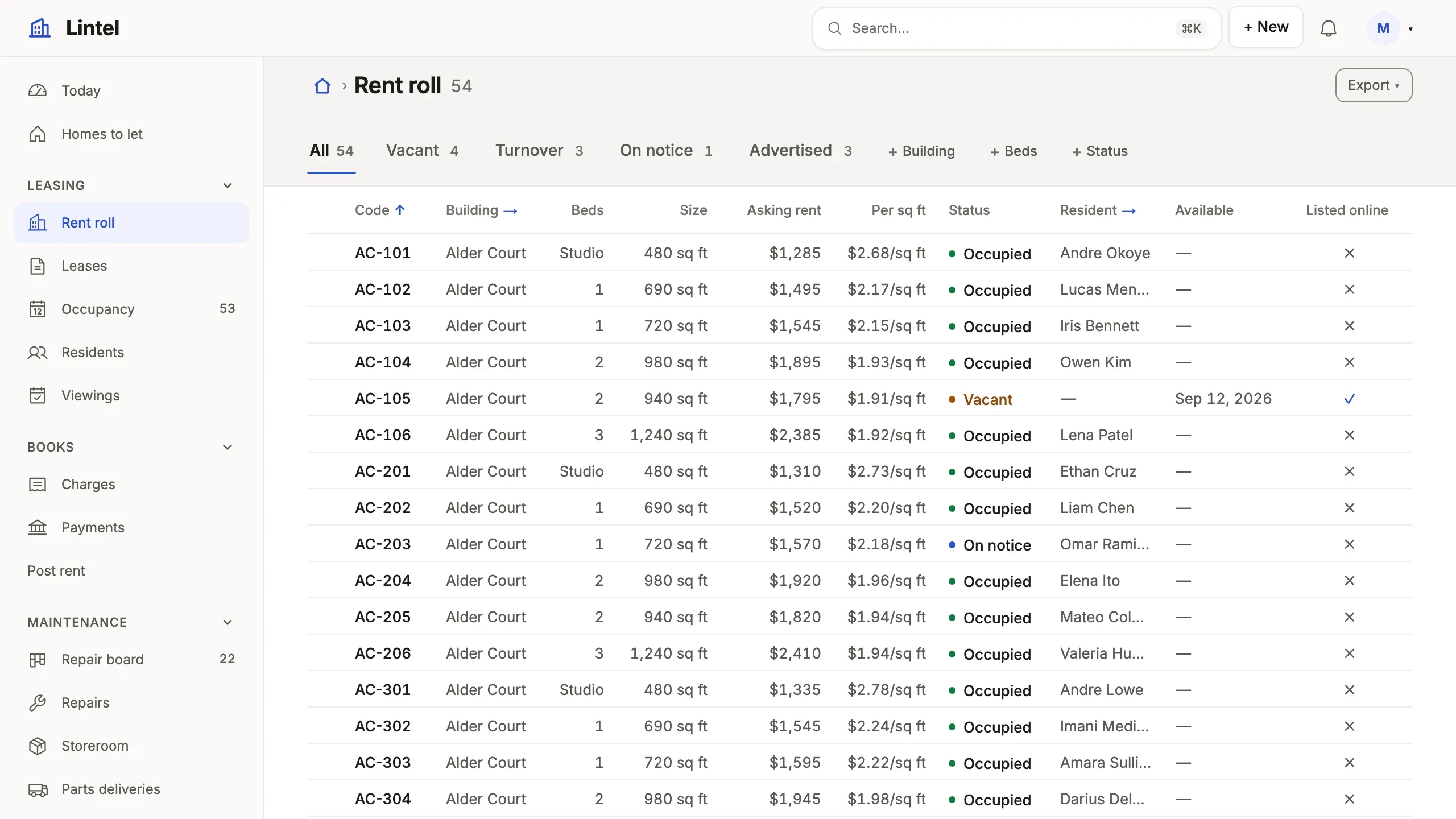
- Always,
show4–7 columns: the name first, then the state, the parent by name (unit_id, drawn as the home’s label), a figure and a date; never a raw id —examples/apps/lintel/views.ts:65. - When the rows are people or companies, an
avatarand a mutedsubtitleon the first column. - When the work divides by state or date,
tabsin the order it is worked, All last —examples/apps/lintel/views.ts:151. - When it is worked by narrowing on three or more facets,
filterBar: 'rail'—examples/apps/lintel/views.ts:28; fewer, the bar’s chips offilters—examples/apps/lintel/views.ts:52. - When triage happens in the list, make those columns
editable—examples/apps/lintel/views.ts:51. - When each row is worked by talking, a
splitwith arow: the queue beside the one picked, its conversation page drawn whole —examples/apps/lintel/views.ts:150. - When a record’s verbs are the work,
rowActions: true—examples/apps/lintel/views.ts:104. - When a figure adds up,
totalsunder the rows —examples/apps/lintel/views.ts:53; when a count or sum of children says more, a rollup such asbalanceshown like a column —examples/apps/lintel/views.ts:86. - When it can be empty, an
emptythat says what belongs there and where it comes from —examples/apps/lintel/views.ts:35. - When the rows are things to look at, a cards
presentation—examples/apps/lintel/views.ts:27.
The keys are in Lists.